Showing posts with label Stealth. Show all posts

31 August 2015

United States Deploy F-22 Raptor to Europe

The United States deploy F-22 fighter jets to Europe as part of a broader effort to support eastern European members of the NATO alliance unnerved by Russia's intervention in Ukraine, Air Force Secretary Deborah James said on Monday.

Four US Air Force F-22 Raptors touched down in Germany on Friday, marking the start of the fighter jet’s first-ever training deployment to Europe.
Four F-22s and 60 airmen from the 95th Fighter Squadron arrived at Spangdahlem Air Base, Germany, on Friday, according to an Aug. 28 statement. One C-17 Globemaster III from the 60th Airlift Wing touched down along with the jets.
The aircraft and airmen will train with allied and US forces through mid-September, according to the statement.
“This inaugural Raptor training deployment is the perfect opportunity for these advanced aircraft to train alongside other U.S. Air Force aircraft, joint partners, and NATO allies,” Gen. Frank Gorenc, US Air Forces in Europe and Air Forces Africa commander, said in the statement.
The training is designed to prove that fifth-generation fighter jets can successfully deploy to European bases and other NATO installations, as well as familiarize pilots with the regional theater. The deployment also will give the US planes a chance to conduct combat air training with different US and European jets, such as the Eurofighter Typhoon.
“It’s important we test our infrastructure, aircraft capabilities, and the talented airmen and allies who will host 5th generation aircraft in Europe,” Gorenc said. “This deployment advances our airpower evolution and demonstrates our resolve and commitment to European safety and security.”
The Air Force announced Monday that the service would send F-22s to Europe for the first time, just weeks after top Pentagon brass began openly calling Russia the greatest threat to the United States. The deployment is part of the European Reassurance Initiative, a Pentagon effort to soothe anxiety among European allies in the face of increased Russian aggression.
Air Force Secretary Deborah Lee James made clear during an Aug. 24 press conference at the Pentagon that the Raptor’s “inaugural” deployment to Europe was designed to send a signal to Russia.
"Rotational forces and training exercises help us maintain our strong and balanced approach, and we will certainly be continuing those in the future," she said. "For the Air Force, an F-22 deployment is certainly on the strong side of the coin."


15 August 2015

Russian Fighter Aircraft Can Easily Defeats The New US F-35's

The Lockheed Martin F-35 Lightning II, described by US media as “a pure gold plane” for its exorbitant price tag, would find itself helpless in a dogfight with Russia’s fourth-generation Su-27 and MiG-29 jets, Pierre Sprey said.

“The Su-27 and even the MiG-29 have bigger wing space, more powerful engines and carry more air-to-air and air-to-ground weapons… That’s why the F-35 will be totally helpless against both because when you confront a plane, which is more maneuverable, accelerates faster and is better armed then you are in trouble,” he added.

Few people are as qualified to speak about fighter aircraft as Pierre Sprey. He is the co-designer of the F-16 Falcon jet and the A-10 Warthog tank buster, two of the most successful aircraft in the US Air Force.

“The F-35 is so bad it is absolutely hopeless when pitted against modern aircraft. In fact, it would be ripped to shreds even by the antiquated MiG-21,” Sprey told RT, commenting on a recent expert report, which dismissed the F-35 project as a total failure.

 According to a report released by the National Security Network, the DOD plans to purchase and operate nearly 2, 500 aircrafts costing US around $1.4 trillion.
In light of that, analyst Bill French wrote a report titled “Thunder without lightning: high cost and limited benefit development program of F-35,” reviewing the new aircraft.
The document states that according to the technical parameters the F-35 is “losing to the fourth-generation fighter MiG-29 and Su-27, developed by the Russian Air Force and used around the world.”
The Soviet MiG-29 and Su-27 fighter aircraft are superior in technical performance than the new US fighter aircraft F-35. The conclusion was reached by the American analyst Bill French, working for a non-profit organization National Security Network.“The F-35 is significantly inferior to the Russian Su-27 and MiG-29 in regard to wing loading (exception — F35C), acceleration and thrust-weight ratio (the ratio of thrust to weight of the aircraft),” said the analyst.
Besides, all of the F-35s have significantly lower maximum speed as compared to the Soviet Union aircrafts. Mr. French also deliberated that in a simulation of air combat, the results draw even “grimmer picture.”
According to him, in 2009 the analysts of US Air Force Intelligence and the Lockheed Martin Company, which developed the new American fighter, noted that despite the superiority of the F-35 in regard to stealth technology and avionics, if compared to the Su-27 and MiG —29 the loss ratio is to be expected 3: 1. That is, for each destroyed Su-27 or MiG-29 there would be three F-35 destroyed. Also, in a real educational dogfight, a veteran in a US Air Force F-16 easily won over the F-35.
The latter clearly did not have enough maneuverability — the aircraft never managed to take a position for launching missiles or firing a gun, while the F-16 managed to catch opponent in sight at least 10 times.
Earlier the problems associated with the F-35 were also noticed in Australia. News.com.au compared the F- 35 to the latest fifth-generation T-50 fighter. The portal noted, judging by the videos, the Russian aircraft significantly exceeds US maneuverability.


13 August 2015

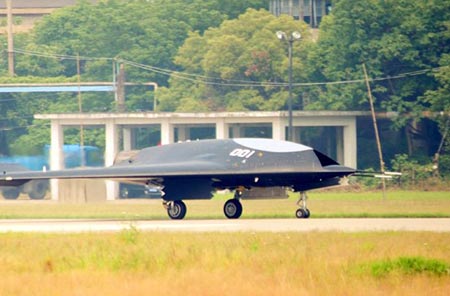
Sharp Sword (Li-Jian or Lijian), The New Chinese Stealth UCAV

China has been testing a number of stealth aircraft over the last few years. The Chengdu J-20 and Shenyang "Falcon Hawk" J-31 have both undergone flight tests, with the expectation that they'll become operational towards the end of the decade.

However, China is pushing hard to match the United States' drone capabilities. Other countries experimenting with unmanned aerial vehicles include Britain, France, and Israel.

Sharp Sword (Li-Jian or Lijian), jointly developed by SYADI, SAU and Hongdu Aviation Industry Group (HAIG), is one of the two models of the AVIC 601-S progressed further than proof of concept design by evolving into larger size (the other being Dark Sword). The Sharp Sword is jet-powered and has a wingspan of 14 meters. It’s not yet known the precise mission Sharp Sword is assigned, but possible missions would including reconnaissance and eventually combat missions.

“The successful flight shows the nation has again narrowed the air-power disparity between itself and Western nations,” state-run newspaper China Daily said in a statement on Friday.

Defense analysts have speculated that the drone is a reverse-engineered copy of Russia’s Mikoyan Skat unmanned aerial vehicle. Not much else is known about the capabilities of the jet-powered drone.

In May, a video of the Sharp Sword taxiing down the runway spread across the internet. Chinese officials said then that they were close to being ready to executive the drones’ first test flight.


12 August 2015

Northrop Grumman X-47B Unmanned Combat Air System

Air worthiness of the X-47B unmanned combat air system demonstrator was developed at an estimated cost of $813m. The aircraft performed a successful initial test flight at Patuxent River, Maryland, in July 2012. The X-47B is expected to enter active naval service by 2019.

The X-47B is an unmanned combat air system carrier (UCAS) being developed by Northrop Grumman for the US Navy (USN). The strike fighter size unmanned aircraft is currently in its demonstration phase. The unmanned aircraft was first developed as part of the X-47 programme.


Development History of the UCAS-D
The X-47B UCAS was developed by the US Navy as part of the unmanned combat air system carrier demonstration (UCAS-D) programme. The programme aims to develop and demonstrate which fighter sized tailless unmanned aircraft can be deployed from US Navy aircraft carriers.

The X-47B is a variant of Pegasus X-47A which was developed as a joint USAF and USN programme, called J-UCAS, in 2001. The programme was funded by the DARPA with Northrop Grumman as the main contractor. In February 2006, however, the Joint-UCAS development programme was cancelled for separate UAV development programmes by both the defence forces. Development of the X-47B, which had started in June 2005, was temporarily halted following the cancellation.

The US Naval Air Systems Command (NAVAIR) contracted Northrop Grumman for the construction and demonstration of two X-47B aircraft under the unmanned combat air system demonstrator (UCAS-D) programme, in August 2007. The UCAS-D programme also aims to pave the way for developing potential future carrier-compatible, unmanned systems with little risk.

Companies collaborating on the UCAS-D programme include Rockwell Collins, Goodrich, Lockheed Martin, Parker Aerospace, Honeywell, GKN Aerospace, General Electric (GE), Wind River, Dell, Hamilton Sundstrand, Pratt & Whitney, Eaton and Moog.


Design and features of the X-47B

The tailless unmanned aircraft is 38.2ft long and has a wingspan of 62.1ft. The shape of the aircraft is designed for stealth or low observable relevant requirements. The weapons bay can carry 4,500lb of weapons.

Operations of the computer-controlled X-47B UCAS are smart and its flight control system is autonomous. The navigation of the UCAS is controlled by hybrid global positioning system (GPS) vision-based system. The flight path is preprogrammed and its operations are monitored by a mission operator.
The UCAS is equipped with electro optics (EO), infrared (IR), synthetic aperture radar (SAR), inverse SAR, ground moving target indicator (GMTI), electronic support measures (ESM) and maritime moving target indicator (MMTI) sensors.

The UCAS-D will feature both probe-and-drogue of the US Navy and boom-receptacle mechanisms of the USAF for autonomous air refuelling.


X-47B engine and Performance Details

The X-47B is powered by a Pratt & Whitney F100-PW-220U engine and exhaust system. The aircraft has a high subsonic speed of about 0.45M and range of about 2,100nm. The UCAS can fly to a maximum altitude of 40,000ft.


Testing of the X-47B Demonstration Aircraft

Two autonomous jet-powered X-47B aircraft were built under the UCAS-D programme. The two demonstration vehicles have similar design and hardware features, however, only one is equipped to test aerial refuelling tasks. They can accommodate various kinds of sensors for reconnaissance, intelligence and surveillance and have space for weapon systems. Payload is not installed on the demonstration units.

The first X-47B, including structural proof testing, was completed by October 2009. Named air vehicle 1 (AV-1), the aircraft was transferred to Edwards Air Force Base (AFB) for flight testing in July 2010. The second aircraft, named AV-2, arrived at the base for testing in March 2011.

The first flight test of the UCAS-D was conducted in February 2011. The first catapult launch of X-47B was conducted at an onshore catapult facility at Naval Air Station Patuxent River in November 2012. The first at-sea test phase involving a series of deck handling trials aboard the USS Harry S. Truman (CVN 75) was completed in December 2012.

The aircraft will also be tested for launching, operating and recovering capabilities in a navy carrier operable area of 50nm. The carrier launch, recovery, and deck handling tests are scheduled for 2013, the aerial refuelling demonstrations in 2014.


11 August 2015

BAE System Taranis Stealth UAV

Taranis is notable mostly for its stealth capabilities, which are analogous to those of a conventional stealth plane in terms of design. Its body is angled so as to present only deflecting angles to the ground, minimizing any reflections that might bounce back to be read by the interrogating radar machine. Taranis’ overall mission is to carry out high-speed, high-precision strikes over long distances without detection — this is quite possibly the first real sign of the riskless future of warfare which so many futurists warn. If neither pilot nor plane are ever likely to be in danger, launching a mission could become a much easier decision to make.


Though it might not look like much against the abstract backdrop of the sky, Taranis is no tiny remote-controlled plane. With a 10-meter wingspan, the aircraft is larger than you might expect for an unmanned vehicle; the logistics of both stealth and long-range flight push the design toward a large, mostly flat-ish belly and wings. While the building material is not currently known (and won’t be for many years) it likely incorporates specially light- and radar-deadening materials to weigh in, as it does, at just eight tonnes. With a budget of more than $300 million and more than a million man-hours invested, Taranis is a major part of the UK’s overall strategy for evolving its military in the coming decade. The country has already identified drones as one of the drivers of its next-generation fighting forces, and stealth drones are a necessary component of that push.


This news comes just months after the public learned of probable test flights for the USA’s latest undetectable UAV, the RQ-180 over the military’s (in)famous Area 51 test site. Its predecessor, the RQ-170 Sentinel, is thought to have participated in operations over Afghanistan, Iraq, and Pakistan, among others. In fact, the Chinese military, which has lagged far behind in its development of drone technology, has been testing a stealth drone of its own, named Sharp Sword by the media. In a statement, Chinese government officials claimed that the (possible) introduction of a working stealth drone “has again narrowed the air-power disparity between [China] and Western nations.” And they’re probably right.


In the future, technological advancement in military technology will be less about scaling up technologies (Lockheed’s proposed Mach 6 follow up to the SR-71 notwithstanding) and more about streamlining. Bombs don’t need to get any bigger, nor (most) planes much faster, nor most satellites more accurate. Rather, militaries need to be able to deliver the same bombs with fewer risks to both life and equipment. They need to be able to perform the same strikes while leaving no evidence of their connection to the event — and in a post-Snowden world, that could very well mean cutting the pilot out, too.


Actually, autonomy was a big part of the pitch for Taranis in the first place, but somewhere along the line the autonomy became unpopular. Now, the system has the “technical capability” of flying without a remote pilot, but will apparently not be used that way. It’s easy to get cynical about the truth of such statements, but the fact is that even the US government is approaching military autonomy with difficulty and great care; it’s not unreasonable to think that Taranis might simply struggle with getting autonomy to work. However, the language used implies that this was a policy-based decision — perhaps someone decided it would be best to let the USA deal with any bad press associated with the first autonomous military robot.


Regardless, the functionality is reportedly moot, today. Whatever the reason, remotely controlled Taranis vehicles will be taking to the skies on Britain’s behalf soon enough. Given how long it’s taken to find out about just a test flight, and the impressive claims made for its stealth abilities, it’s entirely possible that it already has.


2 July 2015

Sukhoi T-50 PAK FA Better Than US 5th Generation Fighter?


Sukhoi PAK-FA fifth-generation fighter jet is finalizing tests of its versatile arsenal before deployment next year. Russia’s Air Force chief says there will be no such target on the scene of operations that the fighter would not be able to engage.
When compared to American F-22 or F-35 5G fighter jets, Sukhoi PAK-FA (T-50) is going to “outperform them in all technical aspects,” the commander of the Russian Air Forces, Lieutenant General Viktor Bondarev said on Thursday.
The PAK-FA fighter jet is going to be truly multirole, being able to equally engage targets “on the ground, in the air and on the sea,” he said, confirming that in 2016 the Air Force will first get the aircraft, then in 2017 the PAK-FA will go into serial production.
With the cutting-edge equipment installed on already manufactured machines, there are more features in development to be integrated into the fighter’s systems on later stages, said Bondarev, mentioning “practical stealth” program being applied in the PAK-FA’s development.
Earlier this week Vladimir Mikheev, an advisor to the deputy head of the Radioelectronic Technologies Concern [KRET], said that the Sukhoi PAK-FA fighter jet is “already to some degree a flying robot,” where“the reaction of the aviator is a part of the control loop.”
He also said that PAK-FA is going to be less observable on radars than generally recognized American stealth trendsetter, the F-22 fighter jet.
“The T-50 is now ahead of not only all other fighters of the Russian Army, but also foreign models. For example, the visibility of the American fifth-generation F-22 fighter is 0.3-0.4 square meters," the developer stressed.
The Sukhoi PAK FA’s visibility stands at between 0.1 and 1 square meters, KRET added. The US military officials have expressed a certain concern in regards of the upcoming Russian 5G fighter jet.
“Performance-wise it certainly looks to compete with the Raptor,” The National Interest cited senior US military official comparing the F-22 and PAK-FA.
Last year, former US Air Force intelligence chief Lt. Gen. Dave Deptula commented to the National Interest that PAK-FA has “pretty sophisticated design that is at least equal to, and some have said even superior to US fifth-generation aircraft.”
The National Interest named PAK-FA “an air superiority fighter, rather than a multi-role aircraft like the F-35,” putting the capability to cruise supersonically ahead other features.
According to Bondarev, which mentioned that PAK-FA’s top speed exceeds Mach 2.0, other features are decisive for modern fighter jet, which are “low-signature, wide variety of armament and super maneuverability.”
The Russian Air Force plans to purchase 55 T-50 fighter jets between 2016 and 2020, was reported in December.

Northrop Grumman B-2 Spirit

Designed during the Cold War as the world’s first low-observable or “stealth” strategic bomber, the B-2 Spirit harkens back to the designs of revalutionary engineer Jack Northrop. His “flying wing” design first debuted in 1949 as the YB-49 but was not adopted by the Air Force at the time. The B-2 Spirit is a multi-role bomber capable of delivering both conventional and nuclear munitions. The bomber represents a major milestone in the U.S. bomber modernization program and brings massive firepower to bear anywhere on the globe through previously impenetrable defenses.

The B-2 provides the penetrating flexibility and effectiveness inherent in manned bombers. Its low-observable characteristics give it the unique ability to penetrate an enemy's most sophisticated defenses and threaten its most valued, and heavily defended, targets. Its capability to penetrate air defenses and threaten effective retaliation provides a strong, effective deterrent and combat force well into the 21st century.

The revolutionary blending of low-observable technologies with high aerodynamic efficiency and large payload gives the B-2 important advantages over existing bombers. Its low-observability provides it greater freedom of action at high altitudes, thus increasing its range and a better field of view for the aircraft's sensors. Its unrefueled range is approximately 6,000 nautical miles (9,600 kilometers).

The B-2's low observability is derived from a combination of reduced infrared, acoustic, electromagnetic, visual and radar signatures. These signatures make it difficult for the sophisticated defensive systems to detect, track and engage the B-2. Many aspects of the low-observability process remain classified, however, the B-2's composite materials, special coatings and flying-wing design all contribute to its "stealthiness."

The B-2 has a crew of two pilots, a pilot in the left seat and mission commander in the right, compared to the B-1B's crew of four and the B-52's crew of five. The first B-2 was publicly displayed on Nov. 22, 1988, when it was rolled out of its hangar at Air Force Plant 42, Palmdale, Calif. Its first flight was July 17, 1989. The B-2 Combined Test Force, Air Force Flight Test Center, Edwards Air Force Base, Calif., is responsible for flight testing the engineering, manufacturing and development aircraft on the B-2.

Whiteman AFB, Mo., is the only operational base for the B-2. The first aircraft, Spirit of Missouri, was delivered Dec. 17, 1993. Depot maintenance responsibility for the B-2 is performed by Air Force contractor support and is managed at the Oklahoma City Air Logistics Center at Tinker AFB, Okla.
The combat effectiveness of the B-2 was proved in Operation Allied Force, where it was responsible for destroying 33 percent of all Serbian targets in the first eight weeks, by flying nonstop to Kosovo from its home base in Missouri and back. Allegedly it was a B-2 Spirit which dropped the bombs that destroyed the Chinese embassy in Sarajevo.

In support of Operation Enduring Freedom, the B-2 flew one of its longest missions to date from Whiteman to Afghanistan and back. The B-2 completed its first-ever combat deployment in support of Operation Iraqi Freedom, flying 22 sorties from a forward operating location as well as 27 sorties from Whiteman AFB and releasing more than 1.5 million pounds of munitions. The aircraft received full operational capability status in December 2003. On Feb. 1, 2009, the Air Force's newest command, Air Force Global Strike Command, assumed responsibility for the B-2 from Air Combat Command.

MANUFACTURER

Northrop Grumman Corp.

POWER PLANT

Four General Electric F118-GE-100 engines

PAYLOAD

40,000 pounds

SPEED

High subsonic

RANGE

Intercontinental

CEILING

50,000 feet (15,240 meters)

ARMAMENT

Conventional or nuclear weapons

CREW

Two pilots

1 July 2015

Shenyang J-31 Stealth Fighter


The Shenyang J-31 (F-60) is a fifth-generation, multi-role, twin-engine stealth fighter aircraft being manufactured for the People's Liberation Army Air Force (PLAAF) by Shenyang Aircraft Corporation, an affiliate of Aviation Industry Corporation of China (AVIC). It is the second stealth fighter that China has indigenously developed after the J-20.
The J-31 fighter jet is intended to provide advanced defence capabilities in close-air support, aerial bombing and air interdiction operations. It can also perform suppression of enemy air defences and can be used as a carrier-based fighter on aircraft carriers. Initial operational capability of the aircraft is expected in 2020.
The J-31 prototype (31001) performed its maiden flight on 31 October 2012. A model of the aircraft was exhibited at the China International Aviation & Aerospace Exhibition (Airshow China) held in Zhuhai in November 2012. The J-31 prototype made a test flight during the Zhuhai Air Show in November 2014.
Known as the FC-31 fourth-generation multi-purpose medium fighter, the export variant of the J-31 fighter was also displayed at the Zhuhai Air Show 2014. The FC-31's airframe and control surfaces are similar to those of J-31 but will be outfitted with angled vertical stabilisers, two large internal payload bays and an estimated payload capacity of 2,268kg. It can also be attached with electro-optical and sensor system (EOSS) pod and infrared search-and-track sensors below the nose.

J-31 aircraft design and features

The medium-sized Shenyang J-31 stealth fighter aircraft features diverterless supersonic inlet (DSI) design with bumps and forward-swept inlet cowls. The airframe incorporates a pair of low-aspect ratio trapezoidal planform wings with titanium spars. Each wing has a sweep of 35° and the stealthy design offers reduced radar cross-section (RCS).
The chined fuselage of the J-31 incorporates a pair of tailplanes. The rear edge of the fuselage is hinged with two vertical stabilisers. A rudder is installed on each stabiliser to control the aircraft's movement. The aircraft is fitted with a tricycle landing gear. The nose landing gear consists of double wheels, while the main landing gear has a 'dogleg' structure.
The fighter jet has a length of 16.9m, height of about 4.8m, and a wing span of 11.5m. The empty weight is about 17t and the maximum take-off weight is 25t. The aircraft can carry out missions at medium and low-altitudes.

Cockpit and avionics

The aircraft is operated by a single pilot. The cockpit is enclosed by a transparent, two-piece canopy to provide increased visibility for the pilot. The aircraft can be equipped with state-of-the-art avionics, including multifunctional displays, helmet-mounted sight, an electro-optical targeting system (EOTS), an attitude director indicator (ADI), and advanced sensors and communication systems.

Armament of Shenyang J-31

The Shenyang J-31 stealth fighter can be fitted with one internal cannon, two internal weapons bays in the fuselage and three payload hard-points on each of the two wings. Each internal weapons bay can accommodate up to two missiles.

J-31 fighter engines and performance

The aircraft is powered by two RD-93 afterburning turbofan engines developed by Russian company JSC Klimov. Each engine generates an afterburning thrust of 84kN. The propulsion system also features fixed stealthy nozzles.
The aircraft can fly at a speed of approximately 2,200km/h and will offer a maximum range of over 2,000km when fitted with external fuel tanks. The service ceiling of the aircraft is approximately 20,000m.

The Importance of Mitsubishi ATD-X ShinShin to Japan

Mitsubishi ATD-X ShinShin developed by Japanese Ministry of Defense Technical Research & Development Institute is a first of its kind jet fighter laced up with cutting-edge stealth technology. This fighter plane is being developed as a domestically produced 5th gen fighter to substitute Japan’s fleet of some 49 Mitsubishi F-2 & 135 Mitsubishi F-15 fighter jets later in the decade.
It would be a substitute to, or would complement, the proposed acquisition of Lockheed Martin’s F-35 stealth fighters. ATD-X stands for ‘Advance Technology Demonstrator- X’ and the name ShinShin means the ‘heart’ or the ‘spirit’. The flight of this fighter is scheduled for this current year.
When Japan identified that the F-22 wasn’t going to be exported from U.S.as the U.S. congress had debarred the exporting of these fighters due to safeguard secrets of its technology. This abandonment led Japan to build its own modern fighter fully equipped with stealth and other enhanced technologies.
With a wind tunnel model being tested in 2005 in France, Mitsubishi ATD-X ShinShin made an appearance in Japan’s next in-house fighter plane project. In 2009, the nation realized that F-22 was not going to be exported; and so the development of ShinShin got accelerated. Later on, it was projected that the ATD-X program will lead to an F-3 fighter production by 2027. Reports also indicated a “strike variant” of the ShinShin is also being planned which possibly will replace the Mitsubishi F-2, but nothing has been said or been confirmed by either the Japanese MoD or the JASDF.
The Mitsubishi ATD-X Shinshin will be utilized as a technology demonstrator & research prototype to decide whether in-house advanced technologies for a 5th generation fighter aircraft are doable, & is a 1/3 size model of a promising full-production aircraft.
Shinshin ATD-X will feature innumerable advanced technologies, including a fly-by-optics flight control system, 3-D thrust-vectoring capability, electronic countermeasures, active electronically scanned array radar, and possibly microwave weapon and directed-energy weapons functions in the future. Another feature that is also will be included is the drone controlling system in which it will command UAVs and UCAVs for a number of rules
Besides these features, a further feature called ‘Self Repairing Flight Control Capability’ has also been incorporated with it that will allow it to automatically detect failures in its flight control surfaces and using the remaining control surfaces, attune accordingly to maintain controlled flight.
The ShinShin will not be installed to units, but is an aircraft that will corroborate both the stealth technology not to be picked up on any enemy radar. & the up-level kinetic performance that allows quick turns while moving around at low speed.
General Features:
•    Crew: 1
•    Wingspan: 9.099 meters (29.85 feet)
•    Length: 14.174 meters (46.50 feet)
•    Height: 4.514 meters (14.80 feet)
•    Dry thrust: 10 tonnes (22,046 pounds) each
•    Powerplant: 2 × IHI XF5-1 turbofans
•    Max. takeoff weight: 13 tonnes (28,659 pounds)
•    Thrust with afterburner: 15 tonnes (33,069 pounds) each
•    Maximum speed: Mach 2+


Japan being a technically advanced nation hopes that its own in-house stealth aircraft would mean that the nation won’t have to count on its foreign allies for hi-tech military technology. The home grown stealth technology would also likely to help the nation improve its radar system to its counter regional rivals like China & Russia that are thought to be building their own stealth aircraft. Also Japanese air force would have a hi-tech replacement to its aging fleet of F-4s and F-15s planes. This will help it build and strengthen its air defense.But there are still challenges as its development is expected to skyrocket over the next decade.

China’s 5th Generation Fighter Will Increasing Tense In East Asia


China is in the process of developing its own native fifth-generation fighter to compete with the F-35 Joint Strike Fighter, and Russia’s T-50.

Although China has been secretive about the exact specifications of the aircraft, experts are warning that the plane could be a game-changer in East Asia’s potentially fragile security environment. 

China’s Chengdu J-20 is currently in its fourth round of prototypes. On July 26, the most recent version of the fighter flew for two hours before successfully landing.

Information about the J-20 is limited, but an unnamed Asian government source told IHS Jane’s that upwards of 20 J-20s could be deployed by within the decade. 

The J-20 has evolved rapidly from its first documented prototype in 2011. Each successive prototype has shown a number of design advancements that help the plane evade enemy radar detection. These changes include modifying the plane’s wing size and adjusting the air intakes to maximize stealth. 

It’s likely that China is also outfitting the J-20 with an active electronically scanned array (AESA) radar in the plane’s nose.

AESAs are incredibly powerful radar systems broadcast at a range of frequencies, allowing a plane to remain stealthy in the process. And the use of the AESA in the J-20′s nose marks a striking similarity to the design of the U.S.’s F-35 fifth-generation fighter.

The similarities between the F-35, the F-22, and the J-20 are likely not a coincidence. Aviation expert Carlo Kopp notes that China imitates the basic shapes and skeletal designs of existing aircraft to speed development while minimizing the risk of a costly and embarrassing engineering failure later on. 

“By cleverly exploiting contemporary United States-developed stealth fighter shaping design rules,” Kopp writes for the independent Australian think tank Air Power Australia, “Chengdu engineers were able to rapidly get an excellent basic shaping design with a minimum of risk and cost, and significant long-term stealth performance growth potential.” 

This potential, if China capitalizes on it, could allow the J-20 to achieve levels of stealth on par with, or even exceeding, the F-35.

This stealth capability could put all of East Asia at risk — the integrated air defense systems in the region rely primarily on types of radar that would be incapable of adequately detecting the J-20.

China would have undisputed first-strike superiority throughout a region where tensions are on the rise. Exact details of the aircraft’s fuel capacity and range are unknown, but estimates give the J-20 a striking range of 1,000 nautical miles, which would place Japanese, Korean, Vietnamese and Philippines airfields within reach of China.

And China has simmering economic and territorial disputes with each of these countries. China’s J-20 has likely also benefited from Chinese espionage.

A Chinese entrepreneur was arrested in July after stealing gigabytes of data related to the F-35 and the F-22, along with other U.S. military aviation projects. Previous extensive theft of F-35 data is believed to be the driver of a number of redesigns to the J-20 and the cause of the aircraft’s improvements within each prototype stage. 

However, China is still believed to be a long way from developing a native engine system for the plane. Engines are “the long pole in the tent,” Reuben F. Johnson, a Russian and Chinese military aerospace analysts who writes for Jane’s, told The Diplomat. Until China develops its own engines, it is limited to using Russian imports. 

Ultimately, the overall quality of a plane is just one factor in the aircraft’s effectiveness, David Cenciotti, a military aviation expert and founder of The Aviationist, told Business Insider via email.

“We don’t know much about the J-20, but it is safe to say it’s not always a matter of technology, armament or on-board equipment,” Cenciotti wrote. “Theoretically, the J-20 will be able to match Western fifth-gen fighters in a one vs one confrontation, but a realistic engagement with airborne early warning and emissions control procedures would be something much different” .

And, as Cenciotti warns, training and logistics may be the most important factor. And if China can get that right, they’ll have a fighter plane that can overcome their rivals’ existing air defenses, and even match the over trillion-dollar F-35.

Sukhoi T-50 PAK FA Fighter Jet Can Defuse Enemy Plane’s Stealth Capability


Russia’s fifth-generation Sukhoi T-50 PAK FA fighter jet is equipped with an advanced defense system that can neutralize an enemy plane’s stealth capability, a report said Friday, citing a unit of Russian state corporation Rostec. The planes, which will go into mass production in 2017, are claimed to be capable of outperforming the F-22 and fifth-generation F-35 fighters of the U.S. Air Force.

The T-50 PAK FA fighter jet will be built with composite materials, and come with advanced electronic systems and engines to ensure the plane can stay mostly undetected by radars and other optical and infrared technologies, Russia’s Sputnik News reported.

“The PAK FA is already to some degree a flying robot, where the aviator fulfils the function not only of pilot, but is actually one of the constituent parts of the flying apparatus,” Sputnik News quoted Vladimir Mikheyev, the deputy head of the Concern Radio-Electronic Technologies (KRET), a unit of Rostec, as saying.

KRET has created an advanced internal navigation system for the T-50 PAK FA jet, which autonomously processes navigation and flight information. The system can also determine position and motion parameters in situations when there is no satellite navigation, and make contact with GLONASS, Russia’s satellite-based navigation system, which works alongside the Global Positioning System.

The Russian air force will get 55 Sukhoi T-50 PAK FA jets by 2020 and the aircraft will replace the country’s Sukhoi Su-27 fourth-generation fighter jet. Russia is also expected to buy at least 50 Tupolev Tu-160 “Blackjack” heavy strategic bombers, which will be produced simultaneously with the country’s new bomber, called PAK DA.


The F-22 Raptor Bloodies Its Talons In First Attack Over Syria


It took an air war against a foe with minimal aerial defenses to bring the US air force’s most advanced warplane into combat.
The F-22 Raptor, a stealth fighter jet as star-crossed as it is beloved by the air force, finally took to the skies in anger on Monday night. It joined its more seasoned cousins the F-15 and F-16, as well as the B-1 bomber and armed drones in attacking Islamic State (Isis) training camps, barracks, headquarters and vehicles in north and eastern Syria.
But Isis is hardly the foe that the architects, advocates and congressional allies of the F-22 anticipated the plane fighting.
The F-22 is the air combat version of a luxury vehicle. While it carries air-to-ground missiles and guided bombs capable of precision placement from miles away – something the air force believes makes it a replacement close-air support jet for the infantryman’s best friend, the A-10 – the F-22’s air-to-air missiles and radar-evading stealth gear it to fighting through heavily defended skies above advanced adversaries.
On the ground, Isis may be perhaps the most formidable jihadist army yet, but Russia or China it is not. Its anti-air artillery, usually mounted on trucks or in the form of shoulder-fired missiles, has not been effective, according to US Central Command, even on the sporadic accounts they’ve been fired at all. And Isis anti-air guns are often targeting Predator drones, a slow, low-flying and poorly maneuverable plane – nothing comparable to the supersonic Raptor.
Still, Isis has latched on to territory within Syria, whose government does maintain Russian-made anti-aircraft batteries and its own fighter jets. Most of them are believed to be along the Mediterranean coast, far from eastward Isis positions, and with the US providing notification to the Syrian government ahead of Monday’s strike, it’s unclear if dictator Bashar al-Assad intends to interfere with a US air campaign against a mutual foe. Lt Gen William Mayville, the Pentagon joint staff’s operations director, said Monday that Syrian air defense radar were in “passive” mode when US warplanes struck.
With the presence of the other US warplanes and the absence of advanced air defenses, “we didn’t really use [the F-22] because the mission required it,” said Christopher Harmer, a former navy aviator now with the Institute for the Study of War.
For a program that may cost as much as $67bn – calculating the price per plane is tricky, but it’s in nine figures – the F-22 has yet to deliver on its promises.
Attempting to put a lid on its spiraling expenses, former Pentagon chief Bob Gates in 2009 capped the F-22 fleet at 187 planes (a decision, ironically, that hastened development of an even more expensive family of jets, the F-35 Joint Strike Fighter). Yet technological difficulties have marred the jet for years – most crucially a scary flaw with its oxygen systems that resulted in pilot blackouts and deaths, and left the whole fleet grounded in 2011 twice. The airforce appears to have retaliated against the pilots who exposed the so-called “hypoxia” problem.
But the F-22 is perhaps the air force’s most prized fighter jet, despite missing every combat engagement since it entered the active airfleet in 2007. Even as its Predators and Reapers have become the signature airframe of America’s protracted ground wars and shadow battlefields against terrorism, the Raptor appeals to the air force’s culture of audacious manned – which may explain why the service ensured it would be on-hand in the Middle East for the Syria conflict.
Mayville’s explanation: “What we were looking at was the effects we wanted to see on the target areas, and what platforms in the region would be best suited to do that. We had a large menu of targets to strike from and we chose from there.”
The air force is hoping Monday night’s Syria strikes are an auspicious beginning for the combat career of a fighter jet that best reflects the future the service’s leadership wants.
But with the initial onslaught of Syria strikes encompassing so many warplanes and missiles, which Harmer called a “kind of a weird hybrid strike of a bit of everything”, one reason to use the F-22, the former pilot explained, “is to justify the weapons system”.