Showing posts with label UAV. Show all posts

13 August 2015

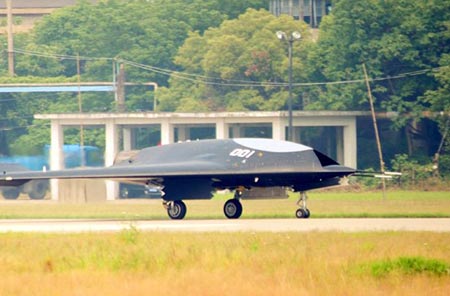
Sharp Sword (Li-Jian or Lijian), The New Chinese Stealth UCAV

China has been testing a number of stealth aircraft over the last few years. The Chengdu J-20 and Shenyang "Falcon Hawk" J-31 have both undergone flight tests, with the expectation that they'll become operational towards the end of the decade.

However, China is pushing hard to match the United States' drone capabilities. Other countries experimenting with unmanned aerial vehicles include Britain, France, and Israel.

Sharp Sword (Li-Jian or Lijian), jointly developed by SYADI, SAU and Hongdu Aviation Industry Group (HAIG), is one of the two models of the AVIC 601-S progressed further than proof of concept design by evolving into larger size (the other being Dark Sword). The Sharp Sword is jet-powered and has a wingspan of 14 meters. It’s not yet known the precise mission Sharp Sword is assigned, but possible missions would including reconnaissance and eventually combat missions.

“The successful flight shows the nation has again narrowed the air-power disparity between itself and Western nations,” state-run newspaper China Daily said in a statement on Friday.

Defense analysts have speculated that the drone is a reverse-engineered copy of Russia’s Mikoyan Skat unmanned aerial vehicle. Not much else is known about the capabilities of the jet-powered drone.

In May, a video of the Sharp Sword taxiing down the runway spread across the internet. Chinese officials said then that they were close to being ready to executive the drones’ first test flight.


Divine Eagle, Chinese Super Drone

The Shen Diao, or Divine Eagle, remotely piloted aircraft is being developed by China’s Shenyang Aircraft Corporation and appears from Chinese Internet photos made public recently to be larger than the U.S Air Force’s Global Hawk long-range surveillance drone.
In late June 2015, new photos emerged of the Divine Eagle prototype, allowing a clearer look at its details. The Divine Eagle has a single engine nestled between its tailfins, with a diameter of over 1 meter. This makes the engine likely to be a medium non-afterburning turbofan producing 3 to 5 tons of thrust, which in turn is usually enough to power a UAV of 12-18 tons in maximum takeoff weight. In comparison, the largest American UAV in open service, the RQ-4 Global Hawk, uses a F-137-RR-100 turbofan engine with 3.4 tons of thrust. The Divine Eagle has a five wheel landing gear layout. The double bodied layout was chosen in order to provide the surface area for carrying large radars, while minimizing internal volume and weight.

Rep. J. Randy Forbes, (R., Va.) a member of the House Armed Services Committee, said Chinese support for systems such as the Shen Diao drone is part of a long-range, well-funded military buildup.

“This particular UAV appears to advance targeting capabilities that China would use in an anti-access, area denial campaign,” Forbes said, using the term for unmanned aerial vehicle.

“While the Chinese military modernization continues to march forward, this administration threatens to veto the defense authorization bill due to the fact that it does not fully fund the IRS and EPA,” Forbes added.

Rick Fisher, a China military affairs analyst with the International Assessment and Strategy Center, said ultimately Beijing could develop such twin-fuselage UAVs to carry large missiles for satellite launching, anti-satellite and anti-ship missions.
“China’s construction of large long-range Global Hawk-sized unmanned aircraft will greatly assist its goal of consolidating control over the western Pacific,” said Fisher.

“These large UAVs will act as persistent satellites able to target missiles and other tactical platforms well beyond the first island chain,” he added.

China’s defense strategy, outlined in a document made public this week, calls for increasing the range of its military forces further from coasts through what the Chinese call two island chains, stretching from northeast Asia through the South China Sea.
A Pentagon spokesman did not return emails seeking comment. Former Pentagon official Mark Stokes said the PLA is investing heavily in research, development, and acquisition of advanced airborne sensor platforms.

“A high altitude, long endurance UAV appears to be a high priority,” Stokes said, noting that two competing designs are probably in play.

“The deployment of high-altitude, long endurance UAVs equipped with advanced sensors would enhance the PLA’s ability to strike U.S. bases and naval assets in the region, as well as those of its allies and partners,” said Stokes, now with the Project 2049 Institute, a think tank.

U.S. intelligence agencies have been closely monitoring Chinese drone developments. China is currently deploying drones for reconnaissance and ocean surveillance over disputed maritime territories, including near Japan’s Senkaku Islands, which China is claiming as its territory.
China also recently tested armed combat drones during military exercises. Current Chinese military writings have outlined plans for using long-range drones for integrated air and sea warfare.

The Shenyang company is also building China’s first unmanned combat aircraft, a design that appears similar to the U.S. X-47B unmanned combat jet. China plans to deploy its combat drone on aircraft carriers.

The aircraft is part of China’s so-called anti-access strategy that includes development of aircraft, missiles, anti-satellite weapons and other systems designed to keep enemy forces from operating close to Chinese borders.

China’s development of the new long-range drone began with talks with Russian aircraft technicians at the Sukhoi Aircraft Corporation during the early 2000s.
The discussions focused on China’s interest in purchasing the Sukhoi S-62 twin-fuselage high-altitude, long-endurance unmanned aerial vehicle.

At the time, the Russians apparently did not have the resources to develop the S-62. However, China, known for its economic and military espionage and technology acquisition prowess, was able to obtain key insights into the aircraft’s design without funding co-development with Moscow.

“Shen Diao’s development has been rumored on Chinese web pages since 2012 and hinted at for much longer by other Chinese sources,” Fisher said.

“The twin fuselage configuration allows the UAV to carry more fuel for endurance, without having to master very advanced new materials for a much stronger wing. It also provides more area for radar arrays,” he added.

Fisher said China’s development of the new drone means the U.S. military should develop long-range range strike systems, including intermediate-range missiles.

Such missiles are currently banned under the 1987 Intermediate-range Nuclear Forces treaty with Russia, which Moscow is violating. The Russians have developed and tested new missiles that violate the accord and so far are refusing to come back into compliance with the treaty.

Congress is pressuring the Obama administration through current defense authorization bills for a response to the INF violation. Among the options being considered are additional missile defenses and new intermediate nuclear strike weapons.


12 August 2015

Northrop Grumman X-47B Unmanned Combat Air System

Air worthiness of the X-47B unmanned combat air system demonstrator was developed at an estimated cost of $813m. The aircraft performed a successful initial test flight at Patuxent River, Maryland, in July 2012. The X-47B is expected to enter active naval service by 2019.

The X-47B is an unmanned combat air system carrier (UCAS) being developed by Northrop Grumman for the US Navy (USN). The strike fighter size unmanned aircraft is currently in its demonstration phase. The unmanned aircraft was first developed as part of the X-47 programme.


Development History of the UCAS-D
The X-47B UCAS was developed by the US Navy as part of the unmanned combat air system carrier demonstration (UCAS-D) programme. The programme aims to develop and demonstrate which fighter sized tailless unmanned aircraft can be deployed from US Navy aircraft carriers.

The X-47B is a variant of Pegasus X-47A which was developed as a joint USAF and USN programme, called J-UCAS, in 2001. The programme was funded by the DARPA with Northrop Grumman as the main contractor. In February 2006, however, the Joint-UCAS development programme was cancelled for separate UAV development programmes by both the defence forces. Development of the X-47B, which had started in June 2005, was temporarily halted following the cancellation.

The US Naval Air Systems Command (NAVAIR) contracted Northrop Grumman for the construction and demonstration of two X-47B aircraft under the unmanned combat air system demonstrator (UCAS-D) programme, in August 2007. The UCAS-D programme also aims to pave the way for developing potential future carrier-compatible, unmanned systems with little risk.

Companies collaborating on the UCAS-D programme include Rockwell Collins, Goodrich, Lockheed Martin, Parker Aerospace, Honeywell, GKN Aerospace, General Electric (GE), Wind River, Dell, Hamilton Sundstrand, Pratt & Whitney, Eaton and Moog.


Design and features of the X-47B

The tailless unmanned aircraft is 38.2ft long and has a wingspan of 62.1ft. The shape of the aircraft is designed for stealth or low observable relevant requirements. The weapons bay can carry 4,500lb of weapons.

Operations of the computer-controlled X-47B UCAS are smart and its flight control system is autonomous. The navigation of the UCAS is controlled by hybrid global positioning system (GPS) vision-based system. The flight path is preprogrammed and its operations are monitored by a mission operator.
The UCAS is equipped with electro optics (EO), infrared (IR), synthetic aperture radar (SAR), inverse SAR, ground moving target indicator (GMTI), electronic support measures (ESM) and maritime moving target indicator (MMTI) sensors.

The UCAS-D will feature both probe-and-drogue of the US Navy and boom-receptacle mechanisms of the USAF for autonomous air refuelling.


X-47B engine and Performance Details

The X-47B is powered by a Pratt & Whitney F100-PW-220U engine and exhaust system. The aircraft has a high subsonic speed of about 0.45M and range of about 2,100nm. The UCAS can fly to a maximum altitude of 40,000ft.


Testing of the X-47B Demonstration Aircraft

Two autonomous jet-powered X-47B aircraft were built under the UCAS-D programme. The two demonstration vehicles have similar design and hardware features, however, only one is equipped to test aerial refuelling tasks. They can accommodate various kinds of sensors for reconnaissance, intelligence and surveillance and have space for weapon systems. Payload is not installed on the demonstration units.

The first X-47B, including structural proof testing, was completed by October 2009. Named air vehicle 1 (AV-1), the aircraft was transferred to Edwards Air Force Base (AFB) for flight testing in July 2010. The second aircraft, named AV-2, arrived at the base for testing in March 2011.

The first flight test of the UCAS-D was conducted in February 2011. The first catapult launch of X-47B was conducted at an onshore catapult facility at Naval Air Station Patuxent River in November 2012. The first at-sea test phase involving a series of deck handling trials aboard the USS Harry S. Truman (CVN 75) was completed in December 2012.

The aircraft will also be tested for launching, operating and recovering capabilities in a navy carrier operable area of 50nm. The carrier launch, recovery, and deck handling tests are scheduled for 2013, the aerial refuelling demonstrations in 2014.


Drone Can Hack Into Your Mobile Device

Drones are ideal for this kind of operation, because they are very good at loitering over an area for a long time, and sending back lots of captured data in real time. But there’s an easy solution for anyone wanting to hide on the ground: avoid logging in to unfamiliar Wi-Fi networks when a drone is overhead.

According to emails posted by Wikileaks, aviation giant Boeing was in talks with Italian offensive cyberwar contractor Hacking Team to make a drone that could hack into computers from the sky.

The scheme proposed the use of unmanned aerial vehicles (UAVs or drones) to deliver Hacking Team's Remote Control System Galileo spyware via Wi-Fi networks from above. Boeing subsidiary Insitu and representatives of Hacking Team enthusiastically discussed the deal after meeting up at the International Defense Exposition and Conference (IDEX) in Abu Dhabi back in February.

Putting the plan together would involve developing a ruggedized and miniaturized Tactical Network Injector (TNI), Hacker News reports. This mini-TNI would be used to introduce malicious traffic into insecure Wi-Fi networks while perched on a drone and subject to jolts and low temperatures. Malicious traffic injection would only work in this scenario in cases where a target is surfing in an insecure, open Wi-Fi hotspot (coffee shop, transport hub, etc.) without using protective VPN technology.

Insitu, developer of the small ScanEagle surveillance drone and other aerospace kit for military and law enforcement applications, outlined the basic premise of the development plan in one leaked email exchange.

Hacking Team responded to the suggestion with enthusiasm, but the plan itself doesn't appear to have progressed much beyond the planning stages before Hacking Team's email spool was leaked by hackers following a high-profile breach earlier this month. It's unclear who the ultimate customers of the aerial malware delivery system might have been. The email exchanges outlining the plan were first reported by Glenn Greenwald's The Intercept here.

The idea of combining spyware and drones may not in itself be new. The alleged leader of Mexico's infamous Los Zetas gang was captured two years ago using a combination of commercial computer spyware, GPS mobile tracking, and aerial drones. The operation to capture Miguel Treviño Morales – also known as "Z-40" – may have involved spyware for law enforcement from Hacking Team rival Gamma International, as The Register noted at the time.

The Mexican government was a customer of Gamma's FinFisher software, according to local reports. The exact role of spyware in the arrest – much less whether it was delivered by a drone – remains unclear, partially because Gamma International declined our invitation to explain how its technology has helped in the arrest of an alleged Mexican cartel leader without bloodshed.


11 August 2015

BAE System Taranis Stealth UAV

Taranis is notable mostly for its stealth capabilities, which are analogous to those of a conventional stealth plane in terms of design. Its body is angled so as to present only deflecting angles to the ground, minimizing any reflections that might bounce back to be read by the interrogating radar machine. Taranis’ overall mission is to carry out high-speed, high-precision strikes over long distances without detection — this is quite possibly the first real sign of the riskless future of warfare which so many futurists warn. If neither pilot nor plane are ever likely to be in danger, launching a mission could become a much easier decision to make.


Though it might not look like much against the abstract backdrop of the sky, Taranis is no tiny remote-controlled plane. With a 10-meter wingspan, the aircraft is larger than you might expect for an unmanned vehicle; the logistics of both stealth and long-range flight push the design toward a large, mostly flat-ish belly and wings. While the building material is not currently known (and won’t be for many years) it likely incorporates specially light- and radar-deadening materials to weigh in, as it does, at just eight tonnes. With a budget of more than $300 million and more than a million man-hours invested, Taranis is a major part of the UK’s overall strategy for evolving its military in the coming decade. The country has already identified drones as one of the drivers of its next-generation fighting forces, and stealth drones are a necessary component of that push.


This news comes just months after the public learned of probable test flights for the USA’s latest undetectable UAV, the RQ-180 over the military’s (in)famous Area 51 test site. Its predecessor, the RQ-170 Sentinel, is thought to have participated in operations over Afghanistan, Iraq, and Pakistan, among others. In fact, the Chinese military, which has lagged far behind in its development of drone technology, has been testing a stealth drone of its own, named Sharp Sword by the media. In a statement, Chinese government officials claimed that the (possible) introduction of a working stealth drone “has again narrowed the air-power disparity between [China] and Western nations.” And they’re probably right.


In the future, technological advancement in military technology will be less about scaling up technologies (Lockheed’s proposed Mach 6 follow up to the SR-71 notwithstanding) and more about streamlining. Bombs don’t need to get any bigger, nor (most) planes much faster, nor most satellites more accurate. Rather, militaries need to be able to deliver the same bombs with fewer risks to both life and equipment. They need to be able to perform the same strikes while leaving no evidence of their connection to the event — and in a post-Snowden world, that could very well mean cutting the pilot out, too.


Actually, autonomy was a big part of the pitch for Taranis in the first place, but somewhere along the line the autonomy became unpopular. Now, the system has the “technical capability” of flying without a remote pilot, but will apparently not be used that way. It’s easy to get cynical about the truth of such statements, but the fact is that even the US government is approaching military autonomy with difficulty and great care; it’s not unreasonable to think that Taranis might simply struggle with getting autonomy to work. However, the language used implies that this was a policy-based decision — perhaps someone decided it would be best to let the USA deal with any bad press associated with the first autonomous military robot.


Regardless, the functionality is reportedly moot, today. Whatever the reason, remotely controlled Taranis vehicles will be taking to the skies on Britain’s behalf soon enough. Given how long it’s taken to find out about just a test flight, and the impressive claims made for its stealth abilities, it’s entirely possible that it already has.


Russian Unmanned Aerial Vehicle Program

The new long-range unmanned aerial vehicle (UAV) will soon be made in Russia. Russian Deputy Defense Minister Yuri Borisov recently announced that this new drone will be able to conduct reconnaissance missions and also be capable of attacking targets. “We are finalizing research and development work related to the drones that will solve an array of tactical, operational and strategic tasks,” the deputy defense minister elaborates.

He further notes that this new combat drone, developed by several Russian aviation firms, including Sukhoi and Tranzas, will be used by the Russian Defense Ministry and the Federal Security Service (FSB). However, Borisov refused to provide the public with technical characteristics of this latest addition to Russia’s burgeoning UAV program.
In 2012, Vladimir Putin announced that “unpiloted aircraft are being used more and more actively in armed conflicts; and I must say, they are being used effectively.” He added, “We need the full line, including automated strike aircraft, reconnaissance drones and other systems… It is imperative to involve best engineering and science bureaus and centers in this effort.” Russia has allocated around $12 billion through 2020 for its UAV development program, which appears to be gaining momentum as of late (e.g., the Altius 001 UAV). In November 2014, Russia also announced that it will build a drone base for military reconnaissance just 420 miles off mainland Alaska.
On January 23, Russia Today broadcasted that the Russian United Instrument Corporation (UIC) (a branch of Rostec Corporation) has constructed two prototypes of the “Chirok” drone, a hybrid amphibious UAV for civilian and military use, and is prepping them for test flights. The article notes that this new drone may first appear in public at the MAKS-2015 air show at Zhukovsky Airfield near Moscow on August 25-30.
Russia Today notes the Chirok’s “outstanding stealth capability” and states that the drone has “enough inner space to fit the weapons, such as small-size guided missiles or high precision bombs, internally, so that they won’t interfere with aerodynamics and stealth characteristics.” The operable range is 2,500 km, and the maximum cruising altitude is reported to be 6,000 meters. The drone also needs no runway for take-off.
However, a 2014 Jamestown Foundation report underlines that statements by domestic Russian arms suppliers “fly in the face of a recent report released by the Russian Foundation of Prospective Research (RFPR) which asserted that UAVs represent an ‘area of technology where [the Russian defense industry has] insufficient competencies.’ The RFPR further noted that optics and electronics systems for light aircraft were an area of ‘low competency.’”
The report further explains, “The development of these advanced UAV systems, in fact, represents a considerable technological challenge for the Russian defense industry, and there are serious questions about whether it can be accomplished without Western cooperation and technological know-how.”
Overall, Russia’s UAV program still lags behind Western efforts in this field and it will take a few more years for Moscow to catch up. “Russia and China’s capabilities are quickly developing. By the end of the decade, if certainly not before, we have intel that shows they’ll have the potential to develop the capability to produce a predator drone on par with American standards,


High-Altitude, Long-Endurance Northrop Grumman RQ-4A/B Global Hawk

The Global Hawk air vehicles are built at the Northrop Grumman (formerly Teledyne Ryan) aeronautical facility in San Diego.

Northrop Grumman Corporation, Ryan Aeronautical Centre is the prime contractor and the principal suppliers include Raytheon Systems (sensors), Rolls-Royce North America (turbofan engine), Boeing North American (carbon fibre wing) and L3 Communications (communications system). The programme is funded by the Defense Airborne Reconnaissance Office (DARO) and managed by the Defense Advanced Research Projects Agency (DARPA) and the US Air Force.

RQ-4A Global Hawk is a high-altitude, long-endurance unmanned aerial reconnaissance system which provides military field commanders with high resolution, near real-time imagery of large geographic areas.


Development
In March 2001, the US Department of Defense awarded Northrop Grumman a contract for the Engineering and Manufacturing Development (EMD) phase of the programme which concluded in February 2003 with the final delivery of the seventh pre-production (block 0) vehicle.

In June 2001 a contract was placed to begin low-rate initial production (LRIP) for two production air vehicles and the mission control element of the system's ground station, to be completed by December 2003.

The first production vehicle (block 10) rolled out in August 2003. A further LRIP contract for four vehicles was placed in February 2003 and a third in October 2004 for two vehicles. Block 10 deliveries were completed in June 2006.

The US Navy had two RQ-4A air vehicles delivered in 2005. In April 2008, the USN selected the RQ-4N marinised variant of the Global Hawk RQ-4B Block 20 for the broad-area maritime surveillance (BAMS) unmanned aircraft system (UAS) requirement.

The system design and development (SDD) contract awarded to Northrop Grumman requires the delivery of two UAVs with mission payloads and communication suites, one forward operating base mission control system, one systems integration laboratory and one main operating base mission control system.

The RQ-4N will have a Northrop Grumman active electronically scanned array (AESA) radar, Raytheon electro-optic / infrared sensors, L-3 communications suite and Sierra Nevada Corp. Merlin electronic support measures (ESM). The RQ-4N is planned for service entry in 2014.


RQ-4B Next Generation Reconnaissance Drone

Northrop Grumman is developing the next-generation, RQ-4B, which has a 50% payload increase, larger wingspan (130.9ft) and longer fuselage (47.6ft), and new generator to provide 150% more electrical output. Three RQ-4B air vehicles (block 20) were initially ordered plus a further five ordered in November 2005. Block 20 aircraft also have an upgraded sensor suite.

The first block 20 Global Hawk completed a maiden flight in April 2007 and the first was delivered in June 2008. 26 block 30 with a signals intelligence (SIGINT) payload will be ordered and 15 block 40 with the multi-platform radar technology insertion programme (MP-RTIP) radar, to enter service from 2011. The US Air Force plans a total of 54 air vehicles.

The block 40 Global Hawk, with the multi-platform radar technology insertion programme (MP-RTIP), has been selected by Nato for the alliance ground surveillance (AGS) programme. The original proposal had manned and unmanned elements but the Alliance decided to go ahead with a UAV-only programme in September 2007. Northrop Grumman will be the prime contractor.
The Australian Defence Force has plans to purchase a squadron of Global Hawks to replace a number of P-3C Orion maritime patrol aircraft.


Global Hawk's Record-breaking Flights

In April 2001, Global Hawk made aviation history when it completed the first non-stop flight across the Pacific Ocean by an unmanned, powered aircraft, flying from Edwards AFB, California, to the Royal Australian Air Force Base, Edinburgh, South Australia.

Global Hawk successfully participated in a series of exercises with the RAAF, the Royal Australian Navy and the US Navy. Guinness World Records has recognised the flight as the longest (13,840km) by a full-scale unmanned aircraft.

In August 2003, Global Hawk became the first UAV to receive authorisation from the US Federal Aviation Administration (FAA) to fly in national airspace.


Unmanned Reconnaissance Capability

Global Hawk can carry out reconnaissance missions in all types of operations. The 14,000nm range and 42-hour endurance of the air vehicle, combined with satellite and line-of-sight communication links to ground forces, permits worldwide operation of the system.

High-resolution sensors, including visible and infrared electro-optical systems and synthetic aperture radar, will conduct surveillance over an area of 40,000nm² to an altitude of 65,000ft in 24 hours.

Six Global Hawk demonstrator vehicles have been deployed in support of Operation Enduring Freedom in Afghanistan since 2002 and Operation Iraqi Freedom since 2003, completing over 4,300 combat hours.

Two ex-USAF Global Hawk demonstrators were transferred to NASA's Dryden Research Center at Edwards AFB, California in January 2008, for use as airborne science research platforms.


Flight and Navigation Control

The vehicle's flight control, vehicle management software and navigation functions are managed by two integrated mission management computers (IMMC) developed by Vista Controls Corporation, California. The IMMC integrates data from the navigation system and uses Kalman filtering algorithms.

The prime navigation and control system consists of two KN-4072 INS/GPS (inertial navigation system / global positioning system) systems supplied by Kearfott Guidance & Navigation Corporation of Wayne, New Jersey.

The KN-4072 includes a monolithic ring laser gyro (MRLG) which operates in conjunction with an embedded differential ready C/A code GPS receiver for enhanced navigation performance and faster satellite acquisition. A Northrop Grumman (Litton) navigation system is installed on the IR/TV/SAR payload.

Sensors

Raytheon Space & Airborne Systems supplies the Global Hawk integrated sensor suite (ISS) which includes the synthetic aperture radar and the electro-optical and third-generation infrared sensor system.
A 10in reflecting telescope provides common optics for infrared and electro-optical sensors. The electro-optical / infrared sensor operates in the 0.4 to 0.8 micron visible waveband and the 3.6 to 5-micron infrared band. In spot collection mode the coverage is 1,900 spots a day with spot size 2km² to a geological accuracy of 20m circular error of probability. In wide area search mode, the swath is 10km wide and the coverage is 40,000nm² a day.

The synthetic aperture radar and ground moving target indicator (GMTI) operates at X-band with a 600MHz bandwidth, and 3.5kW peak power. The system can obtain images with 3ft resolution in its wide area search mode and 1ft resolution in its spot mode.

Raytheon is contracted to supply one enhanced integrated sensor suite (EISS) which is said to improve the range of both SAR and infrared system by 50%.

The Raytheon ground station receives the high-quality imagery obtained by the air vehicle sensor suite. The ground system forwards the imagery to military commanders and users in the field.

Northrop Grumman is prime contractor, with Raytheon as major subcontractor, for the USAF multi-platform radar technology insertion program (MP-RTIP). MP-RTIP is an active electronically scanned array (AESA) radar that can be scaled in size for different platforms.

Three MP-RTIP systems are being built for Global Hawk and three for the E-10A multi-sensor command and control aircraft (MC2A).

In January 2006, a Global Hawk made its first flight carrying Northrop Grumman's high-band system production configuration unit (HBS PCU), part of the USAF's airborne signals intelligence payload. Northrop Grumman is also looking at other payloads including hyperspectral sensors for chemical and biological agent detection.

In November 2003, Global Hawk completed a series of flight tests in the USA and Germany carrying an EADS electronic intelligence (ELINT) payload. The 'Euro Hawk' is being offered to the German Air Force as a replacement SIGINT platform.

In February 2007, the German Air Force awarded a contract to Eurohawk GmbH (a joint venture company formed by Northrop Grumman and EADS) for the development of Euro Hawk.


Communications

Global Hawk has wide band satellite data links and line of sight data links developed by L3 Communications. The 'bulge' at the top front surface of the fuselage which gives Global Hawk its distinctive appearance, houses the 48in Ku-band wideband satellite communications antenna. Data is transferred by Ku-band satellite communications, X-band line-of-sight links and both Satcom and line of sight links at UHF-band.


Survivability

For increased survivability the mission is planned for threat avoidance using available theatre assets such as AWACS, combat air patrol and JSTARS. The aircraft flies high at a loiter altitude 65,000ft which minimises exposure to surface-to-air missiles. The aircraft's modular self-defence system includes an AN/ALR 89 radar warning receiver, an on-board jamming system and an ALE 50 towed decoy system.


Air Vehicle Construction

The wings and tail of the aircraft are of graphite composite construction. The V-configuration of the tail, built by Aurora Flight Sciences, provides a low radar and infrared signature. The wings, constructed by Vought Aircraft Industries, have a span of 116.2ft, with hard points for external pods up to 1,000lb each. Vought and ATK are fabricating an enhanced wing, one of a number of system improvements to enable Global Hawk to carry an increased payload.

The aluminium fuselage contains pressurised payload and avionics compartments. Honeywell Aerospace, Torrance, California, supplied the environmental control systems.

The landing gear is supplied by Heroux Inc. of Quebec, Canada. The nose gear which is a derivative of the F-5 design is height adjustable to suit the runway characteristics. The landing gear automatically retracts at an altitude of 4,000ft.

Global Hawk is equipped with an AE 3007H turbofan engine supplied by Rolls-Royce North America. The engine is mounted on the top surface of the rear fuselage section with the engine exhaust between the V-shaped tail wings. Smiths Aerospace is providing a new electric generator system to more than double electrical power.


Mission Planning

Mission planning for the Global Hawk was developed by GDE Systems Inc (now BAE Systems, Electronics & Integrated Solutions). The Raytheon Intelligence & Information Systems mission control ground station includes a shelter measuring 8ft×8ft×24ft housing the communications, command and control, mission planning and image processing computers with four workstations for the mission control staff and officers. The mission control centre has data up- and down-links to the Global Hawk vehicle directly and via the Ku satellite and the UHF satellite systems.

The Raytheon launch and recovery ground station is housed in an 8ft x 8ft x 10ft shelter equipped with two workstations and the launch and recovery mission computers. The launch and recovery station has up- and down- data communications links to the Global Hawk vehicle and to the UHF communications satellite.


Transportability

The complete mission control element (MCE) and the launch and recovery element (LRE) is transportable in a single load on the C-5B transporter aircraft and in less than two loads on the C-17 transporter.


10 August 2015

General Atomic RQ-1 / MQ-1 / MQ-9 Reaper

A contract was awarded to General Atomics Aeronautical Systems in January 1994 to execute the Tier II, medium-altitude endurance Predator programme. The Predator system first flew in 1994 and entered production in August 1997.

RQ-1 Predator is a long-endurance, medium-altitude unmanned aircraft system for surveillance and reconnaissance missions. Surveillance imagery from synthetic aperture radar, video cameras and a forward-looking infrared (FLIR) can be distributed in real-time both to the front line soldier and to the operational commander, or worldwide in real-time via satellite communication links. MQ-1, armed with AGM-114 Hellfire missiles, is the multi-role version which is used for armed reconnaissance and interdiction.


Predator UAV Operations and Deployments
Predators are currently in production for the US Air Force and are operational with the USAF 11th and 15th Reconnaissance Squadrons. More than 125 Predators have been delivered to the USAF. 36 additional MQ-1B Predators (with Hellfire missile installation kits) were ordered in September 2007. Six Predator UAVs are in service with the Italian Air Force. Italian company Meteor was responsible for assembly of five of the six. The Italian system was deployed to Iraq in January 2005.

Predator UAVs have been operational in Bosnia since 1995 in support of Nato, UN and US operations and as part of Operation Enduring Freedom in Afghanistan and Operation Iraqi Freedom, flying more than 500,000 flight hours on over 50,000 flights. The MQ-1 Predator achieved initial operating capability (IOC) in February 2005.

General Atomics is the prime contractor and the main subcontractors include: Versatron / Wescam for the electro-optical Skyball Gimbal, Northrop Grumman for the synthetic aperture radar, L3 Communication for the wideband satellite communications link, and Boeing for the intelligence workstation and mission planning system.

In February 2001, the Hellfire-C laser-guided missile was successfully fired from a Predator air vehicle in flight tests at Nellis air force base, Nevada. In November 2002, a Predator UAV was used to drop a Hellfire missile in Yemen, which destroyed a civilian vehicle carrying suspected terrorists. A Northrop Grumman Bat submunition was successfully dropped and a FINDER mini-UAV launched from a Predator UAV in August 2002.

In 2011, GA-ASI signed two separate agreements with CAE and RUAG Aerospace Services to offer the Predator B UAS to Canada and the Federal Republic of Germany respectively.

In June 2013, GA-ASI signed a memorandum of understanding with Fokker Technologies to offer the Predator B RPA to support the Dutch Government's medium-altitude long-endurance (MALE) capabilities. It further partnered with Spanish engineering company SENER to offer Predator B RPA to the Spanish Government in March 2015.

GA-ASI and Rohde & Schwarz (R&S) partnered in May 2014 to integrate R&S' air traffic control radios on the Predator aircraft. A pre-production due regard radar (DRR) was tested aboard the Predator B RPA in February 2015.

GA-ASI delivered three Predator B/MQ-9 Reaper systems to the French Ministry of Defence, as of May 2015. France plans to acquire a total of 12 aircraft by 2019.


Predator B Skywarrior

In May 1998 General Atomics was awarded a Block 1 upgrade contract to expand the capabilities of the Predator system. System upgrades include development of an improved relief-on-station (ROS) system which allows continuous coverage over areas of interest without any loss of time on station, secure air traffic control voice relay, Ku-band satellite tuning and implementation of an air force mission support system (AFMSS).

The upgrade also covers a more powerful turbocharged engine and wing de-icing systems to enable year-round operations. The upgraded Predator, the Predator B, was first operational in the Balkans.
In August 2005, a version of Predator B, called Sky Warrior, was chosen for the four-year system development and demonstration (SDD) phase of the US Army's extended range / multi-purpose (ER/MP) UAV programme, comprising 11 Sky Warrior systems, each with 12 air vehicles and five ground control stations.

Initial operating capability was achieved in 2009. Two Block 0 Sky Warrior UAVs were deployed to Iraq in April 2008. GA-ASI received $195.5m in funding from the US Army for the low-rate initial production of the Sky Warrior unmanned aircraft in July 2010.

Also in August 2005, the US Department of Homeland Security / Customs and Border Protection (DHS/CBP) ordered two Predator B systems for monitoring of the US' south-west border. The first was delivered in late 2005, the second in September 2006. Two further systems were ordered in October 2006, for monitoring operations on the border with Canada.


MQ-9 Reaper Hunter / Killer UAV

In March 2005, the USAF awarded a further contract for the system design and development (SDD) of MQ-9 Reaper Hunter / Killer. 21 MQ-9 have been ordered and eight delivered to the USAF. The first USAF MQ-9 squadron, the 42nd Attack Squadron, was formed in March 2007, based at Creech AFB in Nevada.

The USAF first deployed the MQ-9 Reaper to Afghanistan in October 2007 for precision airstrikes. The MQ-9 Reaper flew its first operational mission in Iraq in July 2008.

The MQ-9 Reaper has an operational ceiling of 50,000ft, a maximum internal payload of 800lb and external payload exceeding 3,000lb. It can carry up to four Hellfire II anti-armour missiles and two laser-guided bombs (GBU-12 or EGBU-12) and 500lb GBU-38 JDAM (joint direct attack munition). In May 2008, a USAF Reaper successfully test dropped four Raytheon GBU-49 Enhanced Paveway II 500lb bombs, which have laser and GPS guidance.

The MQ-9 sensor payload can include the General Atomics Lynx SAR (synthetic aperture radar). Lynx also features ground moving target indicator technology. The Predator is to be flight tested with a L-3 communications tactical common datalink (TCDL).

In September 2006, the UK requested the foreign military sale (FMS) of two MQ-9 Reaper systems with Lynx SAR, multi-spectral targeting systems and one ground station. Deliveries began in mid-2007 and the RAF deployed the system in Afghanistan in November 2007. In January 2008, the UK requested the sale of ten additional MQ-9 systems.

In August 2008, Italy requested the sale of four MQ-9 Reaper systems with three ground stations. The USAF accepted the final MQ-1 Predator aircraft in March 2011.

In June 2015, the Italian Directorate for Air Armaments and Airworthiness (DAAA) selected CAE to develop upgrades to a Predator UAS Mission Trainer for the Predator A and Predator B/MQ-9 aircraft developed for the Italian Air Force. Delivery of the trainer is expected in 2017.


System Components

A typical Predator system configuration would include four aircraft, one ground control system and one Trojan Spirit II data distribution terminal. The Predator air vehicle is 27ft in length and has a 49ft wingspan. The system operates at an altitude of 25,000ft and at a range of 400nm.

The endurance of the air vehicle is more than 40h and the cruise speed is more than 70kt. The air vehicle is equipped with UHF and VHF radio relay links, a C-band line-of-sight data link which has a range of 150nm and UHF and Ku-band satellite data links.


Payload

The surveillance and reconnaissance payload capacity is 450lb and the vehicle carries electro-optical and infrared cameras and a synthetic aperture radar. The two-colour DLTV television is equipped with a variable zoom and 955mm Spotter. The high-resolution FLIR has six fields of view, ranging between 19mm and 560mm.

The Raytheon multi-spectral targeting system (MTS-A) is fitted on the MQ-1/9 Predator. The MTS-A provides real-time imagery selectable between infrared and day TV, as well as a laser designation capability. MQ-1 can employ two laser-guided Hellfire anti-armour missiles with the MTS.

The Northrop Grumman TESAR synthetic aperture radar is fitted on the MQ-1 and provides all-weather surveillance capability, has a resolution of 1ft. Other payload options, which can be selected to meet mission requirements, include a laser designator and rangefinder, electronic support and countermeasures and a moving target indicator (MTI).

The USAF equipped a number of MQ-1 and MQ-9 Predators with a version of the Northrop Grumman airborne signals intelligence payload (ASIP) in 2010. Northrop Grumman was awarded a contract for the development and flight testing of the system on an MQ-1 in April 2008. ASIP has also been tested on the U-2 reconnaissance aircraft and fitted on the RQ-4 Global Hawk.


Ground Station

The UAV ground control station is built into a single 30ft trailer, containing pilot and payload operator consoles, three Boeing data exploitation and mission planning consoles and two synthetic aperture radar workstations together with satellite and line-of-sight ground data terminals.

The ground control station can send imagery data via a landline to the operational users or to the Trojan Spirit data distribution system which is equipped with a 5.5m dish for Ku-band ground data terminal and a 2.4m dish for data dissemination.


Operation

Predator follows a conventional launch sequence from a semi-prepared surface under direct line-of-sight control. The take-off and landing length is typically 2,000ft. The mission can be controlled through line-of-site data links or through Ku-band satellite links to produce continuous video.

Video signals received in the ground control station are passed to the Trojan Spirit van for worldwide intelligence distribution or directly to operational users via a commercial global broadcast system. Command users are able to task the payload operator in real-time for images or video on demand.